Start with your monthly electricity use in kWh, from your KPLC bill or token history. Divide by 30 for daily use, then divide by your area's peak sun hours (roughly 5 in much of Kenya) and allow for system losses to get panel capacity in kW. Size the inverter to your peak load and the battery to what you need during evenings and outages.
"What size solar system do I need?" It's the first question almost every homeowner asks, and the answer that separates a system that pays for itself from one that disappoints. Too small, and your batteries die at 9 pm while you're still paying KPLC. Too big, and you've spent money on capacity you'll never use.
The good news: you don't need to be an engineer to understand the basics. This guide walks through the same logic a professional installer uses, so you can sanity-check any quote you receive.
Step 1: Find out how much energy you actually use
Everything starts with kilowatt-hours (kWh), the "units" on your KPLC bill or token receipt. One kWh is the energy a 1,000 W appliance uses in one hour.
- Postpaid customers: your bill shows the units consumed each month. Look at several months, since usage changes with seasons, school holidays and guests.
- Prepaid (token) customers: add up the units from your token purchases over two or three months and average them.
If you only know what you spend, you can estimate units by dividing your monthly spend by your effective cost per unit. That cost includes levies, adjustments and taxes on top of the base tariff, so check a recent bill or token receipt for a realistic figure.
Once you have monthly kWh, divide by 30 for your daily energy use.
Step 2: Understand your peak sun hours
Solar panels are rated for output under strong, direct sunlight. "Peak sun hours" converts a real day of changing sunlight into the equivalent number of hours at that full strength. Much of Kenya receives roughly 4.5 to 6 peak sun hours a day depending on location and season, which is excellent for solar by global standards. Many installers use about 5 as a planning figure and adjust for your area and the rainy seasons.
Step 3: Calculate your solar panel capacity (kW)
The basic formula is:
Panel capacity (kW) = daily kWh ÷ peak sun hours ÷ system efficiency
System efficiency accounts for real-world losses (heat, dust, wiring, inverter conversion and battery charging). A planning figure of around 0.75 to 0.8 is common.
Worked example:
A home uses 300 kWh a month → 10 kWh a day. With 5 peak sun hours and 0.75 efficiency: 10 ÷ 5 ÷ 0.75 ≈ 2.7 kW. An installer would likely propose a system of about 3 kW to cover that home's full daily use.
If you only want to cover daytime use (for a grid-tied system), you'd size smaller. If you're going fully off-grid, you'd size larger to allow for cloudy days.
Step 4: Work out how many panels
Divide the system size in watts by the panel wattage. Modern panels commonly range from about 400 W to 600 W or more.
3 kW = 3,000 W. With 550 W panels: 3,000 ÷ 550 ≈ 5.5 → 6 panels.
Then check your roof: each panel is roughly 2 m² or more, and ideally needs unshaded space facing the sun. Near the equator, panels are usually mounted at a low tilt so rain can wash off dust; your installer will set the angle and orientation for your site.
Step 5: Size the inverter to your peak load
Panels determine how much energy you produce. The inverter determines how much power you can use at the same moment. To size it:
- List the appliances that could run at the same time on your solar circuit.
- Add their running wattage.
- Allow for start-up surge. Fridges, freezers, pumps and some power tools briefly draw several times their running power when they start.
| Appliance | Typical running power | Notes |
|---|---|---|
| LED bulb | 5–12 W | Tiny load. Switch to LEDs first. |
| Wi-Fi router | 10–20 W | Runs 24/7 |
| TV (LED) + decoder | 60–150 W | Depends on screen size |
| Fridge | 100–250 W | Cycles on and off; high start-up surge |
| Laptop | 45–90 W | |
| Microwave | 800–1,200 W | Short use |
| Iron | 1,000–2,000 W | Best used on sunny afternoons |
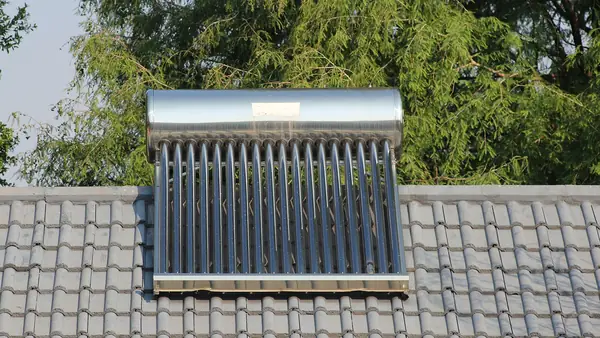
| Electric shower | 3,000–9,000 W | Usually better served by solar water heating |
Figures are typical ranges for planning; check your appliance labels for exact values.
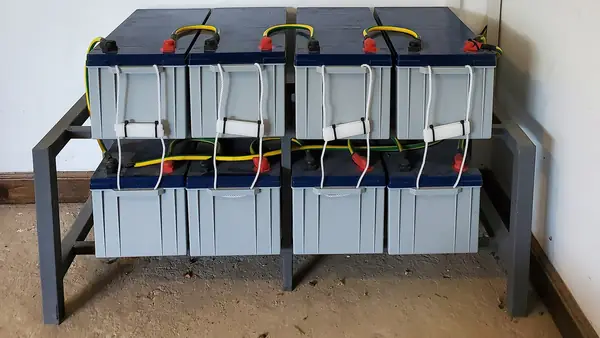
Step 6: Size the battery (if you want backup)
Batteries store energy for the evening and for outages. To size them:
- Estimate the energy (Wh) your backed-up appliances use from sunset to sunrise, or during a typical outage.
- Divide by the battery's usable depth of discharge. Lithium batteries typically allow deep discharge; lead-acid batteries should be discharged much less to last.
- For off-grid systems, add extra storage for cloudy days.
Example: essentials using 3 kWh overnight, with a lithium battery allowing 90% usable depth: 3 ÷ 0.9 ≈ 3.3 kWh → a ~5 kWh lithium battery gives a comfortable margin.
Five sizing mistakes we see all the time
- Sizing from a single month's bill. Use an average of several months.
- Ignoring start-up surges, so the inverter trips every time the fridge and pump start together.
- Including electric showers and cookers on the solar circuit, doubling the system for loads better handled by solar water heating or gas.
- Forgetting the rainy season, especially for off-grid homes.
- Not planning for growth. A new baby, home office, borehole or extra rooms can change your needs. A battery-ready, expandable inverter keeps options open.
Quick reference: from usage to system size
The table below shows how daily energy use translates into approximate panel capacity using 5 peak sun hours and 0.75 efficiency. It's a starting point for conversation, not a design.
| Monthly use | Daily use | Approx. panel capacity | Approx. 550 W panels |
|---|---|---|---|
| 150 kWh | 5 kWh | 1.3–1.5 kW | 3 |
| 300 kWh | 10 kWh | 2.7–3 kW | 5–6 |
| 450 kWh | 15 kWh | 4–4.5 kW | 8 |
| 600 kWh | 20 kWh | 5.3–6 kW | 10–11 |
Future-proofing: plan for how your needs will change
The system you install today should also make sense in three to five years. Before you finalise a size, think about what might change:
- A growing family means more laundry, more devices and more hot water.
- Working from home adds laptops, monitors, printers and daytime air conditioning or fans.
- A borehole or booster pump adds a large motor load with a high start-up surge.
- Extensions and rental units such as a servant quarter, bedsitters or an extra floor add whole new sets of loads.
- Electric vehicles and e-bikes are becoming more common, and charging them at home can add significant daily consumption.
You don't need to pay for all of that today. But you should choose equipment that can grow with you: an inverter with spare capacity or the ability to run in parallel with another unit, mounting space for extra panels, and a battery system that accepts additional modules. That way, expanding later means adding components, not replacing the system you already paid for.
A good installer will ask about these plans during the site survey. If they don't, bring them up yourself.
The bottom line
Solar sizing comes down to four numbers: your daily energy use, your peak sun hours, your peak load and the backup you need. Get those right and the rest follows: panel count, inverter size and battery capacity.
Use the estimator for a rough idea, then let an installer confirm it with a site survey. The survey checks your roof space, shading and wiring, and turns your estimate into a design you can rely on.
Frequently asked questions
How many solar panels do I need for my house in Kenya?
Divide the system size you need (in watts) by the wattage of the panels being quoted. For example, a 3 kW system using 550 W panels needs about 6 panels. The right system size comes from your actual energy use.
How do I find my monthly kWh usage?
Postpaid customers can read it from their KPLC bill. Prepaid customers can add up the units from their token purchases over a few months, or check the purchase history on their meter or via KPLC's services.
What size inverter do I need?
Your inverter must handle the maximum power your backed-up appliances draw at the same time, plus start-up surges from motors such as fridges and pumps. Undersized inverters trip or fail early.
Should I size solar to cover 100% of my bill?
Not always. Covering daytime use gives the fastest payback. Covering evening use requires batteries, which cost more. Many homes aim for the best balance of savings, backup and budget rather than 100%.
Is a bigger solar system always better?
No. An oversized system costs more and may waste energy you can't use or store. The goal is a system matched to your needs, with room to expand later if your usage grows.
How many kWh does an average Kenyan home use?
It varies widely, from a few dozen units a month in small households to several hundred in larger homes with electric showers, pumps and many appliances. That's why sizing should always start from your own bills rather than an average.
BrightSun Solar designs and installs solar power, battery backup, solar water pumping and solar water heating for homes, businesses, farms and institutions in Nairobi and across Kenya. Installations are carried out by EPRA-licensed technicians. Why customers choose us.
Get a system sized to your real usage
Tell us about your property in 60 seconds. We'll reply on WhatsApp with next steps and book a free site survey.